
Austin Kleon doesn’t believe in the term “genius.”
He makes the argument that no great work of art it born from isolation. “If you believe in the lone genius myth,” Kleon states in his book, Show Your Work, “creativity is an antisocial act, performed only by a few great figures–mostly dead men with names like Mozart, Einstein, or Picasso.”
Kleon then runs the other direction, citing Brian Eno’s term “scenius.”
According to Eno, a scenius is “the intelligence and intuition of a whole cultural scene, […] the communal form of the concept of the genius.”
Kleon expands Eno’s definition by saying, “great ideas are often birthed by a group of creative individuals–artists, curators, thinkers, theorists, and other tastemakers–who make up an ‘ecology of talent.’ […] Being a valuable part of a scenius is not necessarily about how smart or talented you are, but about what you have to contribute–the ideas you share, the quality of the connections you make, and the conversations you start.”
If you look carefully at the writers, artists, and musicians you admire most, in all likelihood, they were a part of a one scenius or another: the Lost Generation romping through Paris in the 1920s, the Beat Generation traversing the country in the 40s and 50s, Laurel Canyon in the 1960s, British punk in the 1970s, hardcore punk in the 1980’s. The Chelsea Hotel at pretty much a moment in history.
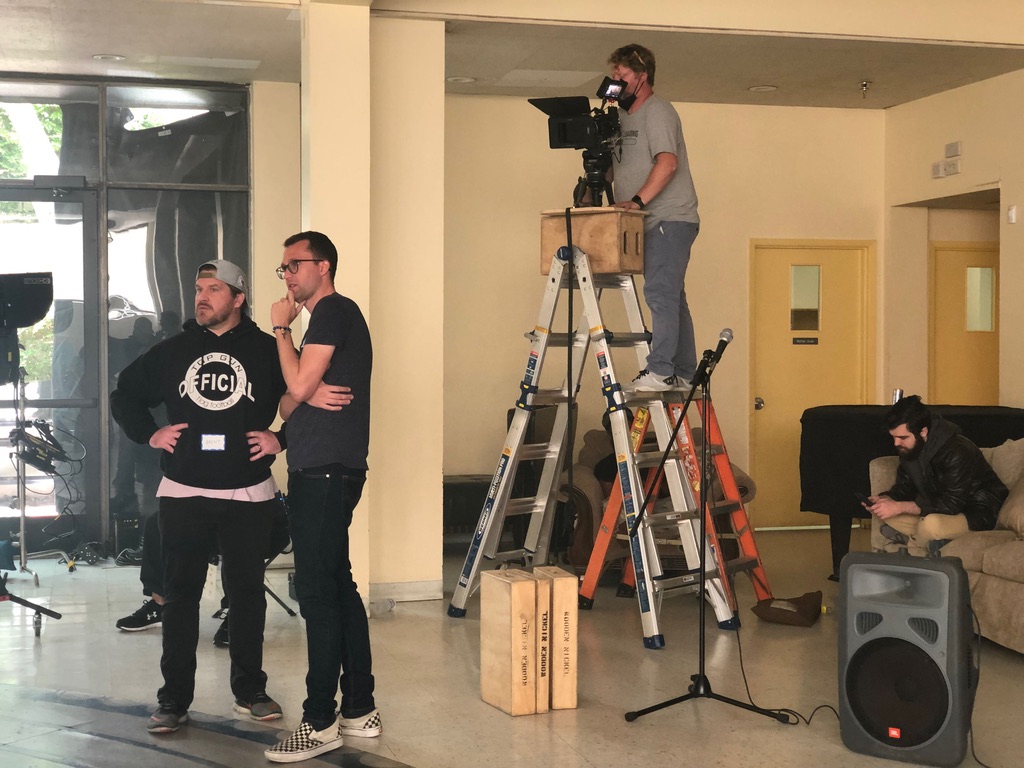
I’ve been fortunate enough to be a part of quite a few sceniuses in my life, each one featuring its own cast of colorful characters, all of whom contributed to the work I was making and the person I became.



The idea of a “scenius” also makes me recall something I learned during my time as a camp counselor: the South African principle of “ubuntu,” which translates roughly as “I am because you are.”
Used frequently by Nelson Mandela and Archbishop Desmond Tutu, ubuntu became a guiding principle of the Truth and Reconciliation Commission as it sought to repair the damage done to the South African people by apartheid.
According to Archbishop Tutu, ubuntu “speaks about our interconnectedness. You can’t be human all by yourself, and when you have this quality – Ubuntu – you are known for your generosity…We think of ourselves far too frequently as just individuals, separated from one another, whereas you are connected and what you do affects the whole world. When you do well, it spreads out; it is for the whole of humanity.”

Based on this definition, I consider “scenius” and “ubuntu” to be synonyms, as both are predicated on the notion of being of service to those around us.
“If we forget about genius and think more about how we can nurture and contribute to a scenius,” Kleon concludes, “we can stop asking what others can do for us, and start asking what we can do for others.”
After all, isn’t creating more fun when you’re doing it with and for someone else?
Further reading: I used to love the fantasy of the recording studio as a physical space for a scenius to inhabit. Of course, if you’re a writer, “the world is your studio…”
And now for something completely different: Woody Allen’s Midnight in Paris does a phenomenal job of capturing the romance of the scenius, while also warning against the trap of “golden age thinking.”
 joshua chamberlain